 GAHUM
GAHUM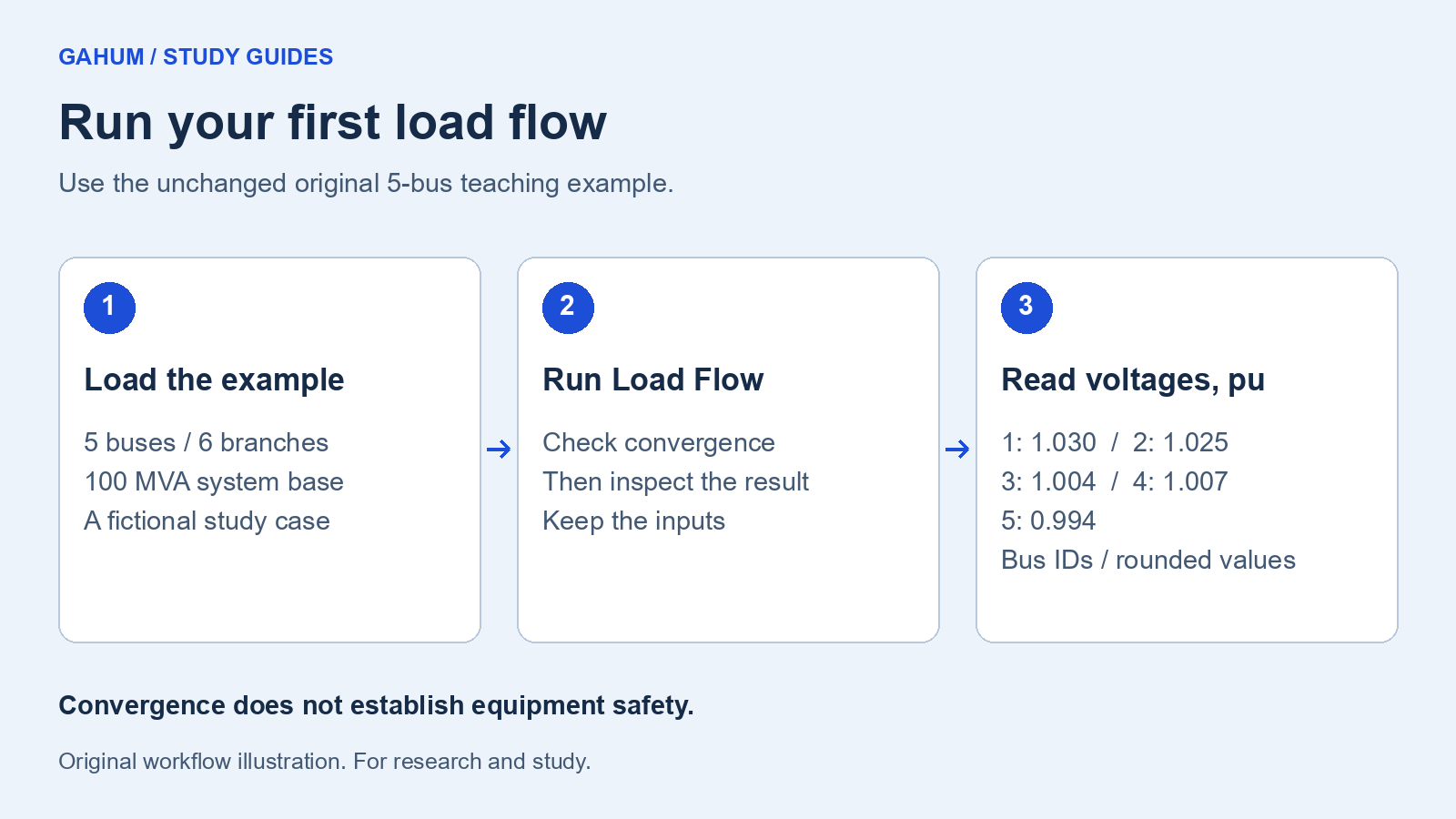
This exercise uses GAHUM's original 5-bus teaching example. It is a fictional study case, not a verified model of operating equipment.
1. Open the example
Loading an example replaces the current Power System. Use a separate browser profile for this exercise if you already have saved work to keep.
- Open GAHUM. The editor starts in the single line diagram, or SLD. Maps are not needed.
- If the controls are hidden, select Show editor.
- In Study example, choose 5-bus original teaching example, then select Load.
You should see five buses and six branches. The case uses a 100 MVA system base.
2. Run the load flow
Select Run Load Flow. Live solve is enabled by default, so a result may already be present. Running explicitly gives you a clear point at which to inspect the result.
The unchanged example should converge. Convergence means the numerical calculation meets its stopping condition. It does not prove that the input data describe a real network or that equipment is safe.
3. Read the bus voltages
A voltage magnitude in per unit, or pu, is relative to that bus's voltage base. A magnitude of 1.00 pu equals its base. A magnitude of 0.994 pu is 0.6% below the base.
For the unchanged example, the load-flow results are approximately:
| Bus | Voltage, pu |
|---|---|
| 1 | 1.030 |
| 2 | 1.025 |
| 3 | 1.004 |
| 4 | 1.007 |
| 5 | 0.994 |
If these differ substantially, reload the example and check for edits or an outaged branch. Do not treat a failed solve as a zero-voltage result.
4. Keep the result and its context
Select Report to review the current case and load-flow result. Continue with Read and export a Study Report.
The example sources and assumptions describe the authored electrical data and separate geographic material. Map geography does not validate the electrical case.